LF2050
Reaping
Early reaping was all done by hand. Reaping is the cutting of the grain. In Egypt a flint blade was used to cut the wheat. In Europe the scythe had been introduced by the Romans. Yet the Europeans continued to use the sickle until limited labor forced them to use the more efficient scythe. (17F) By hand a worker could cut about 0.3 acres in a day. An experiment with an old sickle harvested 6.25 pounds in one hour and was two pounds after being threshed. (24F) After being cut the stalks were tied into bundles and then let to dry. After drying the wheat would be threshed and winnowed. The first evidence of a machine reaper come from the Gauls in Europe.
The Cradlers allowed the the cutter to deposit the shafts in a pile after the swing. They could mow 1.5 to 3 acres in a day. (14F, pg 116)
Later, labor shortage, both in Europe and especially in the Western United States, spurred the farmer on to find new and more efficient ways to harvest his crop. (17F, pg. 53) The first successful reaper was created by Rev. Patrick Bell in the early 1800's. In this design the reaper was pushed by horses with the shears cutting the wheat in front. (14F) The Bell reaper could cut ten acres a day and needed sharpening after fifty acres. (24F)
 |
Bell's reaper as illustrated in Old Farm Tools and Machinery by Percy Blandford. |
One of the largest used early reapers was one made by the McCormack company. The McCormack reaper was widely used and accepted in United States and England. The rest of Europe was much slower to adopt the new technology. In 1890 only one tenth of France or Germany had adopted the use of the reaper in their fields.(17F 54) The reaper would cut the stalks where they would lie in the fields until they were manually pick up. Later a board was added behind the blades and a man would push the stalks off into piles. |
 |
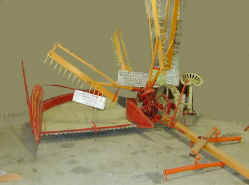 |
The sail reaper came about in 1862. It now replaced a person pushing off the stalks by sail like rakes. The rakes would rotate and clean the stalk off into piles off the side of the machine. Then men would again manually bind up the stalk into bundles. It could harvest five acres in a day. The early reapers required a man to push the wheat off by hand. |
| The reaper was improved to both reap and bind the stalks in later versions by McCormick and other manufactures. McCormack started mass-production of the reaping machines which bound the sheaves in 1877. (#21F) Other manufactures also came out with their own versions of self binding machines. |  |
Threshing and winnowing
Introduction
Plowing | Auto Plow | Cultivators | Planting | Reaping | Threshing
Threshing Machines | Combines | Steam Engines
Internal Combustions Tractors | Bibliography


